
How AI Is Changing Content Marketing
Artificial intelligence is changing the way businesses create, distribute, optimize, and measure content. What once required hours of research, brainstorming, writing, editing, and analysis can now be supported by AI-powered tools and workflows.
From generating content ideas to analyzing customer behavior, AI in content marketing is helping businesses improve productivity while creating more personalized and data-driven marketing strategies.
However, AI is not simply about producing more content. The real opportunity is using artificial intelligence to make content marketing more efficient, relevant, and strategic while keeping human creativity and judgment at the center.
What Is AI in Content Marketing?
AI in content marketing refers to using artificial intelligence technologies to support different stages of the content marketing process.
Businesses can use AI for:
- Content research
- Topic and keyword discovery
- Content planning
- Blog writing
- Social media content
- Email marketing
- SEO optimization
- Content personalization
- Performance analysis
- Content repurposing
- Marketing automation
Instead of replacing the entire content marketing process, AI can assist marketers with repetitive and time-consuming tasks.
This allows marketing teams to spend more time understanding customers, developing creative ideas, building brand authority, and making strategic decisions.
How AI Is Changing Content Marketing
1. Faster Content Research and Ideation
Coming up with valuable content ideas consistently can be challenging.
AI tools can analyze topics, questions, keywords, customer pain points, and existing content to help marketers discover new opportunities.
For example, a digital marketing business could use AI to generate topic ideas around:
- SEO
- Social media marketing
- Google Ads
- Meta Ads
- Lead generation
- Branding
- Website development
- Content marketing
AI can organize these ideas into content clusters, blog topics, social media themes, and campaign concepts.
The marketer’s role remains important because AI-generated ideas need to be evaluated for relevance, originality, search intent, and business value.
2. AI Is Transforming Content Creation
One of the most visible changes is AI-powered content creation.
Businesses can use AI to create first drafts for blog posts, social media captions, email campaigns, product descriptions, video scripts, and website content.
A single content brief can potentially become multiple formats.
For example:
One blog article → LinkedIn post → Instagram caption → email newsletter → video script → carousel → short-form content
This process, known as content repurposing, allows businesses to extend the value of existing content.
However, simply publishing AI-generated text is not a content strategy.
Human editing is necessary to add expertise, examples, brand personality, accurate information, and original insights.
3. AI Is Changing SEO Content Strategy
Search engine optimization and content marketing are closely connected.
AI can help marketers organize keyword research, identify search-intent patterns, develop topic clusters, create content briefs, and find potential content gaps.
Instead of focusing only on individual keywords, marketers can use AI to build broader topic structures.
For example, a business targeting digital marketing services could create supporting content around:
- SEO services
- Social media marketing
- Content marketing
- Google Ads
- Meta Ads
- Lead generation
- Local SEO
- Website optimization
This creates opportunities to build topical authority.
AI can also help identify questions customers may have at different stages of the buying journey.
The important point is that AI should support SEO strategy rather than encourage businesses to mass-produce low-quality pages.
4. Personalized Content at Scale
Customers increasingly expect brands to provide relevant experiences.
AI can help businesses analyze customer information and create different content for different audience segments.
For example, an online business could develop separate messaging for:
- First-time visitors
- Existing customers
- Returning website visitors
- Potential leads
- High-value customers
Personalized content can include emails, recommendations, advertisements, landing-page messaging, and offers.
AI makes it easier to manage variations at scale, although businesses must use customer data responsibly and comply with applicable privacy requirements.
5. AI-Powered Social Media Marketing
Social media requires a constant flow of useful and engaging content.
AI can support social media teams by helping generate content calendars, post ideas, captions, hooks, creative concepts, and content variations.
For example, one monthly campaign can be organized into:
Week 1: Educational content
Week 2: Problem-and-solution content
Week 3: Social proof and case studies
Week 4: Promotional and conversion content
AI can also help marketers adapt content for different platforms instead of publishing identical messages everywhere.
The final content should still reflect the brand’s personality and audience rather than sounding like generic AI copy.
6. Content Repurposing Becomes Easier
Creating original content takes time. Repurposing allows businesses to turn one valuable piece of content into multiple marketing assets.
AI can help transform:
Blog → Social posts → Email → Video script → Infographic → FAQ → Carousel
This can significantly improve content efficiency.
For example, a detailed article about SEO can become a series of short social media posts explaining keyword research, technical SEO, backlinks, search intent, and content optimization.
This approach allows businesses to maintain consistent communication without starting from zero every time.
7. AI Is Improving Content Performance Analysis
Creating content is only half the job. Businesses also need to understand whether their content is producing results.
AI can help marketers analyze metrics such as:
- Website traffic
- Engagement
- Click-through rates
- Conversion rates
- Search visibility
- Leads
- Content performance
- Audience behavior
AI can summarize large amounts of marketing data and highlight patterns that deserve further investigation.
For example, if several articles attract significant traffic but generate few leads, a marketer might investigate whether the content has an effective call to action, relevant offers, or appropriate internal links.
AI can support this analysis, but marketers should verify important conclusions against the underlying data.
8. AI Is Changing Content Marketing Automation
Automation is one of the biggest opportunities created by AI.
Businesses can connect different stages of their marketing workflow:
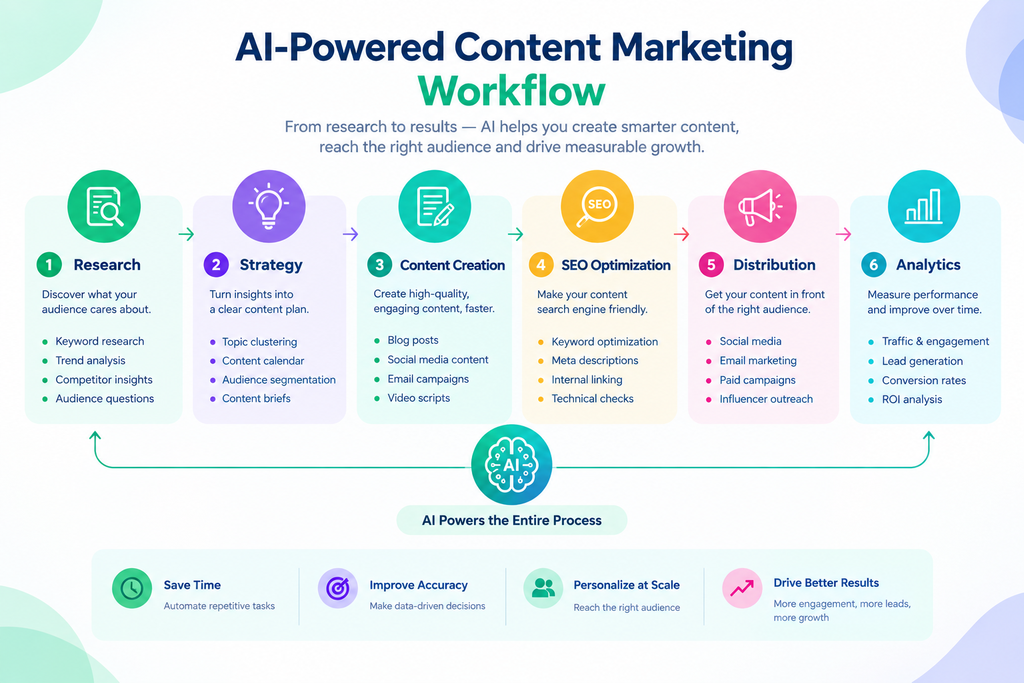
Research → Strategy → Content Creation → Distribution → Lead Generation → Analytics → Optimization
Instead of manually completing every repetitive task, marketers can automate appropriate parts of the process.
This can be particularly useful for small businesses with limited marketing resources.
However, not every task should be automated. Brand strategy, creative direction, sensitive customer communication, and important business decisions require human oversight.
Benefits of AI in Content Marketing
When implemented properly, AI can provide several benefits:
Increased Productivity
AI can reduce the time required for brainstorming, research, drafting, formatting, and repurposing.
Better Content Planning
AI can help organize large numbers of ideas into structured content calendars and topic clusters.
Greater Personalization
Businesses can create more relevant messaging for different customer segments.
Improved Efficiency
Marketing teams can spend less time on repetitive tasks and more time on strategy and creativity.
Data-Driven Decisions
AI can help analyze marketing performance and identify areas that require attention.
The Risks of AI Content Marketing
AI also introduces challenges.
Businesses should not assume that AI-generated content is automatically accurate, original, or effective.
Common problems include:
- Incorrect information
- Repetitive content
- Generic writing
- Lack of original experience
- Inaccurate statistics
- Over-optimization
- Weak brand personality
- Poor differentiation
Another major risk is publishing large volumes of low-value content simply because AI makes production easier.
More content does not automatically mean better marketing.
The goal should be better content, not just more content.
AI and Human Creativity: Finding the Right Balance
The most effective approach is not necessarily AI versus humans.
It is AI + human expertise.
AI can handle tasks such as research assistance, brainstorming, content structuring, repurposing, and data organization.
Humans should remain responsible for:
- Brand strategy
- Original ideas
- Industry expertise
- Fact checking
- Creative direction
- Editorial judgment
- Customer understanding
- Final approval
This combination creates a more practical and sustainable content marketing strategy.
The Future of AI in Content Marketing
AI will continue to influence how businesses create and manage content.
The next stage will involve more connected marketing workflows where research, content creation, SEO, personalization, distribution, and analytics work together.
Businesses that use AI effectively will not necessarily be the ones publishing the largest volume of content.
Instead, sustainable results are more likely to come from businesses that understand their audience, create genuinely useful information, maintain strong brand identity, and use AI to improve efficiency.
Conclusion
AI in content marketing is changing the entire content lifecycle—from research and planning to creation, personalization, distribution, and performance analysis.
For businesses, the opportunity is significant. AI can reduce repetitive work, accelerate content production, support SEO strategies, improve personalization, and help marketers make better use of their data.
But AI should not become a shortcut for producing generic content.
The strongest strategy combines artificial intelligence, human creativity, industry expertise, and data-driven decision-making.
Businesses that find this balance can use AI not simply to create more content, but to build a more efficient and effective digital marketing system.
At LayaEdge, we help businesses strengthen their online presence through SEO, content marketing, social media marketing, paid advertising, lead generation, branding, and website development—using modern marketing strategies and AI-supported workflows where they provide genuine value.